One of the most misunderstood facts in modern investing is this:
Gold is not a fringe asset. It is the largest, deepest, and most established store of value on Earth.
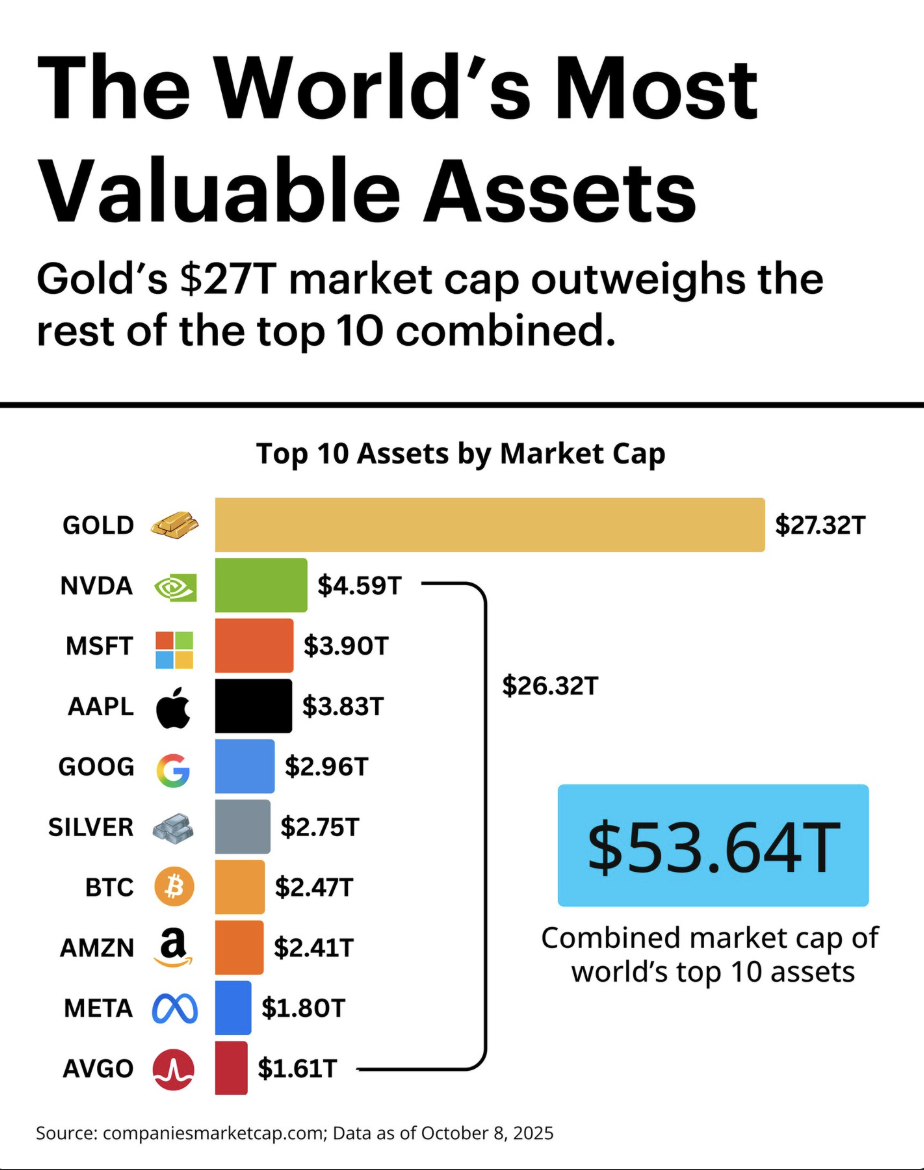
The image above makes that unmistakably clear. With an estimated $27+ trillion market capitalization, gold alone is worth more than the next nine largest assets combined—including the biggest technology companies, Bitcoin, and even silver.
That scale matters. A lot.
⸻
1. Size = Safety (and Gold Is Massive)
In markets, size is not just about bragging rights—it’s about stability, liquidity, and survivability.
Gold’s $27T market cap means:
• It cannot be cornered or manipulated long term
• It absorbs massive capital flows without breaking
• It trades continuously across every continent
• It remains liquid in every economic regime
Many popular assets today are large only because:
• Interest rates were suppressed
• Liquidity was abundant
• Risk was rewarded over safety
Gold earned its size over 5,000+ years, across empires, currencies, wars, and financial systems.
No stock, crypto, or bond can say that.
⸻
2. Gold Is Not Someone Else’s Promise
Every major asset below gold on that list shares a common trait:
They are all financial promises.
• Stocks depend on earnings, management, and regulation
• Bonds depend on governments’ ability to repay
• Crypto depends on networks, software, and confidence
• Even cash depends on central bank discipline
Physical gold depends on none of that.
It is:
• No one else’s liability
• Not issued by a government
• Not dependent on earnings, algorithms, or policy
• Not subject to default
That is why central banks themselves hold gold—not tech stocks, not Bitcoin, not bonds—as the ultimate reserve asset.
⸻
3. Gold’s Role Is Not to “Beat the Market”
This is a crucial distinction.
Gold is not designed to:
• Maximize short-term returns
• Outperform growth assets in bull markets
• Replace productive investments
Gold’s role is to:
• Preserve purchasing power
• Reduce portfolio volatility
• Protect against systemic risk
• Provide liquidity when confidence breaks
In a balanced portfolio, gold is the anchor, not the engine.
Ironically, many investors ignore gold because it is boring—until the moment it becomes essential.
⸻
4. The Bigger the Debt, the More Gold Matters
We are living in an era defined by:
• Exploding government debt
• Persistent inflation
• Negative real interest rates
• Rising geopolitical fragmentation
In that environment:
• Financial assets become more fragile
• Currencies lose purchasing power
• Confidence becomes cyclical
Gold thrives not on panic—but on math and incentives.
When debt cannot be repaid honestly, it is repaid quietly through debasement. Gold simply adjusts.
⸻
5. Gold Balances What Modern Portfolios Lack
Most portfolios today are heavily exposed to:
• Equity risk
• Currency risk
• Interest rate risk
• Policy risk
Gold behaves differently.
Historically, gold has shown:
• Low correlation to stocks and bonds
• Strong performance during inflationary regimes
• Resilience during market stress
• Long-term preservation of real value
This is why even a modest allocation to physical gold can materially improve risk-adjusted returns over full market cycles.
⸻
6. Physical Gold vs “Paper Gold”
It’s important to clarify: when we talk about gold’s safety, we are talking about physical gold ownership, not paper representations.
Physical gold means:
• Direct ownership
• No counterparty risk
• No reliance on financial institutions
• No exposure to rehypothecation
In times of stress, the difference between owning gold and owning a claim on gold becomes very real.
⸻
Bottom Line
The chart above highlights a truth that markets occasionally forget:
Gold is not small, speculative, or outdated—it is the largest and most trusted store of value on the planet.
Owning physical gold is not about fear.
It’s about balance.
In a world dominated by leverage, promises, and financial engineering, gold remains:
• Simple
• Liquid
• Global
• Proven
That is why it belongs in a well-constructed portfolio—not as a bet, but as a foundation.
If you’d like, I can follow this with:
• A breakdown of how much gold makes sense in different portfolio types
• Gold vs silver vs platinum roles
• A historical look at gold’s performance during past debt cycles