Gains spread beyond AI, but underlying risks haven’t vanished

Dear Friend,
2026 is off to the races—S&P’s up 17%, gold’s going full bananas, and even Europe and China decided to RSVP to the bull market.
It’s not just tech doing the heavy lifting anymore—financials, healthcare, and good ol’ small-caps are back like they never left.
The Fed just cut rates again, while arguing with itself in public like a dysfunctional group chat, and Trump’s One Big Beautiful Bill is juicing the economy like it’s leg day.
And oh yeah—Elon’s about to launch a $1.5 trillion SpaceX IPO because apparently the cloud now lives in orbit.
Keep reading this week’s edition of the Everlasting Wealth Insider Report to catch all the headlines.
Jeremy Blossom
Editor in Chief, Everlasting Wealth
MARKETS
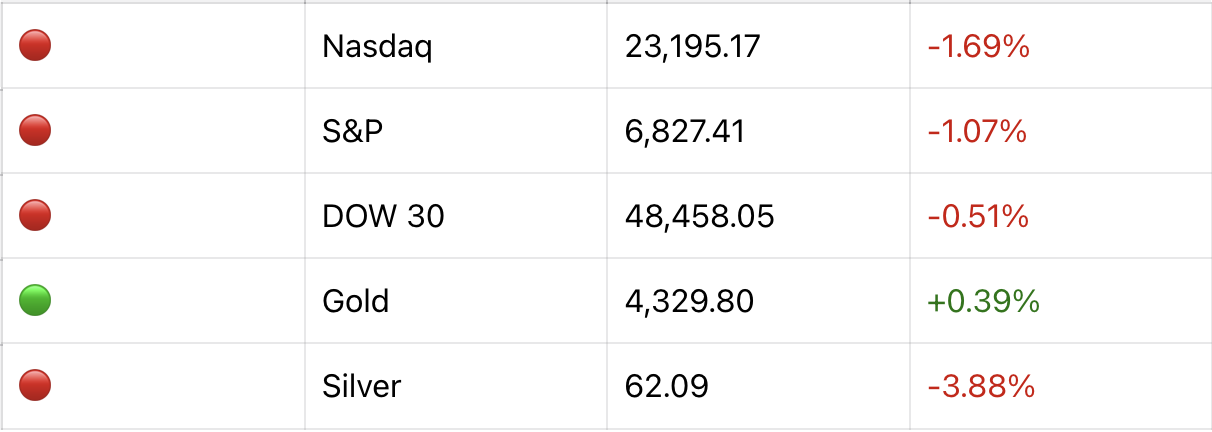
MARKET HEADLINES
💊 Novo Nordisk launched Ozempic in India at just $24 per week—over 90% cheaper than in the U.S.—due to lower costs and weaker patent protections.
🚗 Despite slumping global sales and intensifying competition in China and Europe, Tesla stock rose as investors shifted focus to its AI and robotaxi ambitions.
⚡ Fermi’s stock crashed 43% after losing a $150 million funding commitment for its Texas AI-energy project, though the company remains optimistic about future power demand.
🌿 Cannabis stocks like Tilray and Canopy soared after reports that President Trump plans to ease federal restrictions by reclassifying marijuana as a Schedule III drug.
🧠 Broadcom downplayed the long-term dominance of its AI chips made with Google, aiming to reduce dependency as major clients seek their own custom accelerators.
🥧 Costco posted solid earnings, selling 4.5 million pies ahead of Thanksgiving, but shares dipped as investors worried about slowing membership renewal and tariff impacts.
🧮 Goldman Sachs expects the Magnificent Seven to fuel nearly half of 2026 S&P 500 earnings growth, though broader sectors like industrials and healthcare are gaining strength.
🚀 Nvidia stock has stalled amid AI trade fatigue and Broadcom-Google competition, but new Blackwell AI models in early 2026 may reignite momentum.
🪙 Bitcoin hovered above $92K while Robinhood tumbled 9% on weak trading volumes—yet Cathie Wood’s ARK doubled down, betting on a crypto rebound.
👟 Lululemon stock jumped on a strong Q3 earnings beat and a CEO transition, despite ongoing challenges in North American sales and rising tariff costs.
2026’s Looking MAGA-nificent: Markets Soar, Economy Holds, and It Ain’t Just About AI

Turns out 2025 was no fluke—Wall Street’s still riding high, and 2026 is shaping up to be another banner year.
The S&P 500’s up 17%, gold’s gone bananas, and even Europe and China joined the party.
But here’s the kicker: it’s not just tech and AI anymore.
Trump’s One Big Beautiful Bill is kicking in, the Fed’s getting ready to cut rates again, and the economy’s holding steady thanks to actual grown-up policy for once.
Small-cap and value stocks are back in the game, and sectors like financials and healthcare are making quiet, solid gains.
Sure, the media’s wringing their hands over “valuation risk” and tariffs (shocker), but earnings keep beating expectations—so maybe it’s time they stop betting against the Trump economy.
If you’re looking to invest, think broader than just the AI giants—real America is on sale, and it’s starting to move.
STOCKS 2 WATCH
↘️ Broadcom: Despite impressive revenue growth, investor concerns over sales forecasts, contract backlogs, and long-term margin expectations dragged the chipmaker’s shares down nearly 5% in premarket trading.
↗️ Lululemon: Shares of the athletic apparel brand surged 9% before the bell after CEO Calvin McDonald announced plans to step down in January, amid growing pressure from the company’s founder to reinvigorate the brand’s image.
↗️ UBS: Shares climbed 4% in Switzerland after reports emerged that Swiss legislators are looking to ease proposed capital requirements for the banking giant.
↗️ Warner Bros. Discovery: With growing investor speculation around a potential higher acquisition bid, the media company’s stock rose 1.5% premarket and is tracking toward its best weekly performance since October.
↗️ RH: The luxury furniture retailer saw shares rise 4% ahead of the open despite narrowing its annual revenue forecast and citing tariff-related disruptions such as inventory shortages and price hikes.
↘️ Costco: While membership fee income rose and new warehouse expansion is in the pipeline, shares of the retail giant edged slightly lower in early trading.
Fact of the Week
The “jobs report” is actually two reports released at the same time—the big Establishment Survey of hundreds of thousands of businesses that drives payrolls and wages, and the smaller Household Survey of ~60,000 homes that sets the unemployment rate and labor-force participation—so months when payrolls surge while unemployment ticks up aren’t a contradiction but a measurement quirk that later gets reconciled through revisions, multiple-job holders, and population controls.
ECONOMY
Fed Cuts Rates Again—Because Nothing Screams “Confidence” Like Panic in All Directions
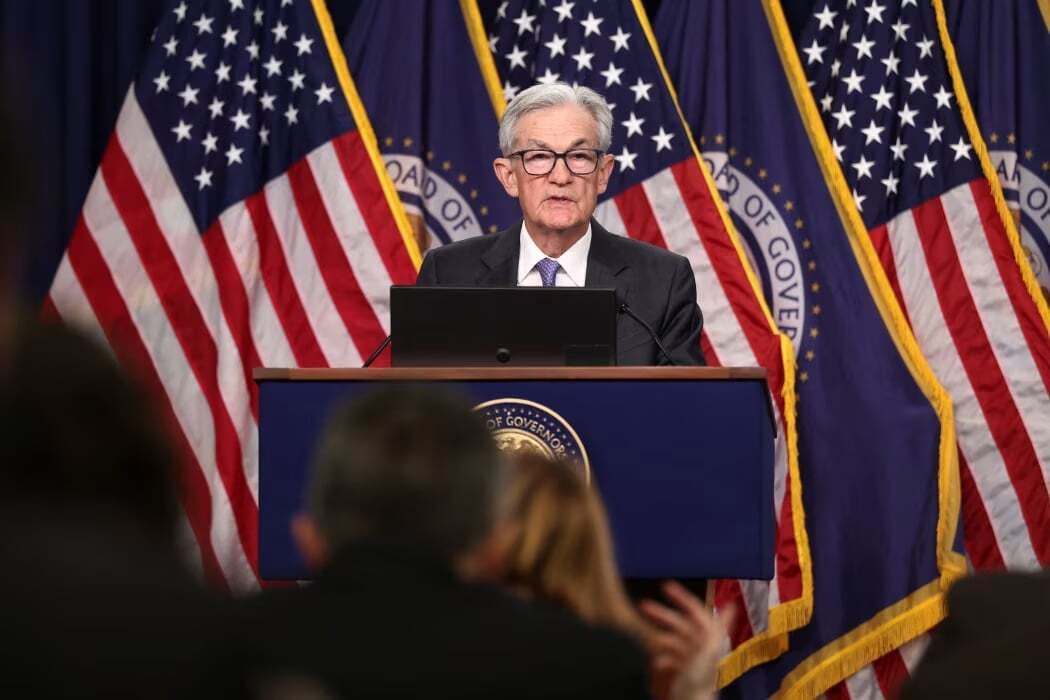
Well, the Fed just cut rates for the third time, bringing us down to 3.5%–3.75%, but don’t get too excited—they’re basically shrugging and saying, “That’s probably it… maybe… who knows?”
This meeting was a hot mess: three officials dissented, and in opposite directions—some wanted no cut, others wanted a bigger one.
Talk about leadership.
Powell’s trying to thread the needle with inflation still sticky and the job market cooling faster than Biden’s approval rating.
Wall Street, of course, threw a party like we’re back in 2021—Dow jumped nearly 500 points.
But underneath the confetti, things look shaky.
The Fed’s clearly worried the Trump tariffs are biting harder than they’ll admit, and Jerome’s trying to keep the ship steady before Trump picks his replacement in May.
The Fed’s guessing, inflation’s still high, and we’ve got more data coming than a CNN fact-checker during a Trump rally. Buckle up.
Economic Headlines
📉 Nasdaq tightened IPO rules to curb fraud after many small listings—especially China-based—plunged post-debut, drawing scrutiny from regulators and the FBI.
🏘️ Housing stocks may rebound in 2026 as falling mortgage rates, tight supply, and possible policy incentives drive a potential long-term recovery.
🌌 SEC’s lone Democrat Caroline Crenshaw warned of a ‘casino-like’ market as Republican-led deregulation, staffing cuts, and crypto favoritism undermine investor protections.
🏦 The Trump administration aims to loosen financial oversight by overhauling the FSOC, boosting big banks and sparking fears of new systemic risks.
🧮 Despite the White House claiming 2.5% inflation, official data shows it’s closer to 3%, with economists warning real household pressures remain elevated.
🎯 Kevin Hassett’s potential Fed nomination raises concerns about independence, as allies question his loyalty to Trump and shifts from earlier economic principles.
🎁 Powell’s dovish tone and the Fed’s pause on hikes have fueled optimism for a Santa Claus rally, potentially lifting the S&P 500 near 7,000 by year-end.
⚖️ Kalshi, Crypto.com, and others formed a coalition to fight state crackdowns on prediction markets, defending federal oversight from the CFTC.
💰 CDs from banks like Marcus and United Fidelity offer stable yields above 4%, making them attractive as savings rates fall with Fed rate cuts.
🔄 Value stocks are outperforming tech as rate cuts boost cyclical demand, with analysts forecasting 36% earnings growth—setting the stage for continued gains.
Trivia
In what year did the U.S. Federal Reserve begin publicly announcing its target for the federal funds rate right after FOMC meetings—an early milestone of modern central-bank transparency that can move Treasury yields, the dollar, and stock-index futures within minutes?
A. 1979
B. 1994
C. 2001
D. 1987
E. 2012
Scroll for the answer
BUSINESS
Musk Aims for the Stars—Literally—With a $1.5 Trillion SpaceX IPO in 2026

Elon Musk might be about to do it again—SpaceX is gearing up for an IPO in 2026 that could slap a $1.5 trillion price tag on the company, putting it in the same league as Tesla.
And just like Tesla left the old-school carmakers in the dust, SpaceX is about to make Boeing and Lockheed look like they’re building paper airplanes.
The big driver?
Starlink’s exploding broadband business and Musk’s new obsession: AI data centers in space—because apparently cloud computing on Earth just isn’t exciting enough anymore.
Investors are foaming at the mouth for anything with “AI” in the pitch deck, and Wall Street loves growth more than a lobbyist loves pork-barrel spending.
So while the value crowd clutches their pearls over “insane multiples,” growth investors are throwing money at anything Musk touches.
Say what you want about the guy, but turning rockets and robots into multi-trillion-dollar empires?
That’s next-level capitalism.
Answer
In what year did the U.S. Federal Reserve begin publicly announcing its target for the federal funds rate right after FOMC meetings—an early milestone of modern central-bank transparency that can move Treasury yields, the dollar, and stock-index futures within minutes?
B. 1994
Starting in 1994, the Fed shifted toward immediate post-meeting communication about policy decisions (rather than leaving markets to infer the stance from open-market operations), which reduced “guessing games,” improved price discovery across rates-sensitive assets, and helped make scheduled Fed communication one of the most market-moving events on the U.S. economic calendar.