
Dear Friend,
The S&P 500 is holding steady in 2025, but individual stocks are on a rollercoaster—Meta is soaring, Alphabet is sinking, and hedge funds are cashing in on the chaos.
Meanwhile, Trump’s tariffs on metals could hike short-term costs for the power grid, but U.S. manufacturers see a golden opportunity to step up production.
In the skies, Airbus is dominating with its new A321XLR jet, stealing Boeing customers while its rival struggles with delays.
But in the long game, the battle for aviation supremacy is far from over.
Let’s dive into this edition of the Everlasting Wealth Insider Report.
Jeremy Blossom
Editor in Chief, Everlasting Wealth
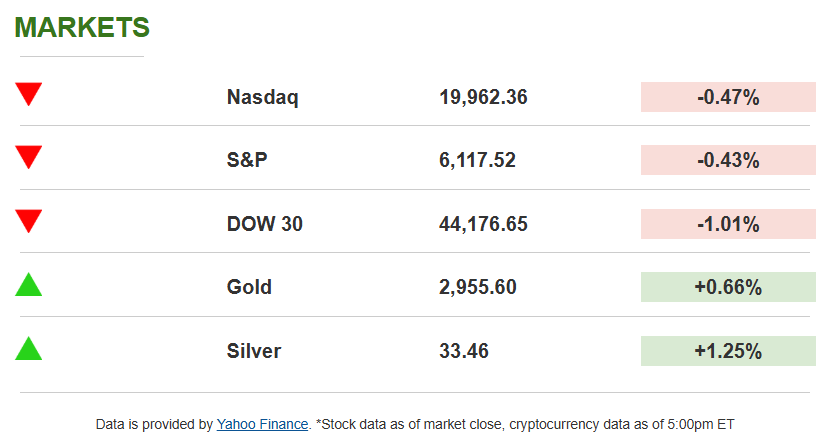
MARKET HEADLINES
₿ Bitcoin rose 1.1% to $97,187, with its recent lack of volatility signaling market consolidation amid macroeconomic uncertainty.
🤖 Alibaba stock surged 8.2% after strong earnings, as AI-driven growth in its cloud segment offset concerns over China’s sluggish consumer spending.
📉 Walmart shares dropped 8% despite solid earnings, as weaker-than-expected guidance raised concerns about slowing growth in 2025.
📊 Palantir stock fell another 2.3% after a 10% slump, as CEO Alex Karp’s stock sale plan and potential defense budget cuts spooked investors.
⚡ Nvidia stock slipped slightly despite a price target upgrade to $190 from KeyBanc, with investors awaiting next week’s earnings report.
🚗 Tesla stock rose 0.4% as analysts shift focus to its upcoming mass-market EV and self-driving robotaxi launch, despite political distractions.
📉 Super Micro stock slipped 2.7%, cooling off after a massive rally that made it the S&P 500’s top performer in 2025.
📊 Carvana stock dropped 8.8% after reporting strong earnings but weaker revenue per vehicle, raising concerns about profitability.
🇺🇸 Trump’s push for an “America-First” stock market faces risks as tariff threats and geopolitical uncertainty shake global investor confidence.
₿ XRP surged 5% on news of Brazil approving the world’s first XRP ETF, fueling speculation about potential U.S. approval.
Stock Market Stays Strong Despite Wild Swings in Individual Stocks

The S&P 500 has remained surprisingly steady in 2025, despite major economic shifts like the rise of Chinese artificial intelligence and the Trump administration’s new tariffs.
While the overall market is up 4.2% this year, individual stocks are experiencing major swings—Meta is up over 10% while Alphabet is down 8%.
Investors are selectively responding to news, rather than selling everything at once, leading to record-high dispersion among stocks.
Some hedge funds are capitalizing on this trend by betting on low index volatility while profiting from individual stock fluctuations.
However, history suggests that market stability can’t last forever—sharp corrections tend to come when investors least expect them.
STOCKS TO WATCH
↘️ Carvana: The used car retailer’s stock has been as volatile as a jalopy with bad suspension. Despite touting “significant growth” in its latest results, investors weren’t sold, sending shares sharply lower in premarket trading.
🔎 Walmart: The retail giant has been on a winning streak, and all eyes are on its quarterly results, set for release at 7 a.m. ET. Key trends to watch include its e-commerce success and ability to attract wealthier shoppers.
🔎 Booking Holdings: As the parent company of Priceline, Kayak, and OpenTable, Booking Holdings’ earnings report after the bell will offer insight into both its business performance and consumer demand for travel and dining.
↗️ Microsoft: The tech giant announced a new chip made from a material that is neither solid, liquid, nor gas—hailed as a breakthrough in quantum computing. Shares climbed Wednesday and continued gaining premarket.
↘️ Palantir: One of the S&P 500’s recent high-flyers took a hit Wednesday and appears set for further declines Thursday, as concerns over defense spending cuts and insider stock sales weigh on the stock. It still trades at several hundred times trailing earnings.
This Day in the Markets
📉 On this day in 2020, global markets began a steep decline as investors grew alarmed by the rapid spread of COVID-19 beyond China, raising concerns about severe economic disruptions, supply chain breakdowns, and potential recessions worldwide; this selloff marked the beginning of a market meltdown that would, within weeks, erase trillions in value and lead to one of the fastest bear markets in history as panic over the unfolding pandemic intensified.
ECONOMY
Investing in America’s Power Grid: How Tariffs Factor In

As America modernizes its power grid to meet rising demand from AI data centers and manufacturing growth, ensuring a stable supply of key equipment like transformers is critical.
With only 20% of domestic transformer demand met by U.S. suppliers, tariffs on steel, aluminum, and potentially copper could increase costs in the short term.
However, these policies also create opportunities for American manufacturers to expand production and reduce reliance on foreign imports.
Companies like GE Vernova are already investing in U.S. facilities, which could strengthen long-term energy independence.
While some regions, like New Jersey, may see temporary electricity price increases, these investments lay the groundwork for a more secure and self-sufficient power grid—key to supporting America’s energy and industrial future.
ECONOMY HEADLINES
🚗 Tesla stock rose 0.3% as investors focused on its upcoming mass-market EV and self-driving robotaxi launch, despite political distractions.
🌍 Trump’s comments on Ukraine shook European markets, but defense stocks like Rheinmetall and BAE Systems surged on rising military spending expectations.
🥚 A bird-flu vaccine could help lower egg prices, but the poultry industry fears trade restrictions and costly implementation.
🏥 Medicare could face changes under Elon Musk’s government efficiency team, with privatization and cost-cutting efforts on the table.
💣 European defense stocks climbed while U.S. defense firms struggled, as Trump’s NATO skepticism fueled speculation of increased EU military spending.
🏛 Trump is backing the House’s sweeping spending bill, but Senate Republicans are pushing a smaller version, setting up a GOP showdown.
🏡 Home builder stocks are having their worst February in five years, as high mortgage rates and rising costs pressure the housing market.
💰 Defense stocks wobbled after reports that the Trump administration warned the Pentagon of potential budget cuts, adding uncertainty for investors.
📉 The Fed signaled no rush to cut rates, saying it needs to see more inflation progress, while new tariffs complicate the economic outlook.
💸 Elon Musk’s DOGE team claims $55 billion in federal savings, but scrutiny over data access and legal battles could slow its aggressive cost-cutting plans.
Trivia
Which of the following taxes generates the largest share of federal revenue for the U.S. government?
A. Corporate Income Tax
B. Excise Tax
C. Payroll Tax
D. Individual Income Tax
E. Estate Tax
Scroll for the answer
BUSINESS
Airbus Gains Ground While Boeing Regroups

Airbus is making major strides in the aviation industry with its new A321XLR jet, racking up over 500 orders and attracting key Boeing customers like American Airlines and United Airlines.
The aircraft’s ability to fly longer distances while remaining fuel-efficient is giving airlines new route options.
Meanwhile, Boeing, dealing with production delays and financial challenges, is working to get its 737 MAX 10 and other models certified.
While Airbus benefits from a strong product lineup and continued investment in new technology, Boeing is focusing on stabilizing its operations and preparing for future aircraft development.
The long-term battle between these two aviation giants is far from over, but for now, Airbus is taking advantage of Boeing’s temporary setbacks.
Answer
Which of the following taxes generates the largest share of federal revenue for the U.S. government?
D. Individual Income Tax
Individual income taxes are the largest source of federal revenue, accounting for around 50% of total U.S. government revenue.
These taxes are collected from wages, salaries, investments, and other personal income sources.
Payroll taxes, which fund Social Security and Medicare, are the second-largest source of revenue.
Corporate income taxes contribute much less, partly due to tax breaks and deductions.
Excise taxes (on goods like gasoline, tobacco, and alcohol) and estate taxes (on inherited wealth) make up only a small portion of federal revenue.