
Dear Friend,
Big Tech just set $40 billion on fire in the name of AI, yet somehow, Nvidia’s stock still tanked because a Chinese startup thinks they can do it better and cheaper.
Meanwhile, Microsoft’s earnings flopped, Meta’s still burning cash like it’s a “strategic advantage,” and Toyota is proving hybrids might be the only sane car choice left.
Oh, and Europe’s economy is falling apart—so naturally, they’re blaming Trump.
And if Monday’s market crash didn’t remind you to diversify your 401(k), maybe the IRS keeping most of your money will.
Here’s what you need to know in this edition of the Everlasting Wealth Insider Report.
Jeremy Blossom
Editor in Chief, Everlasting Wealth
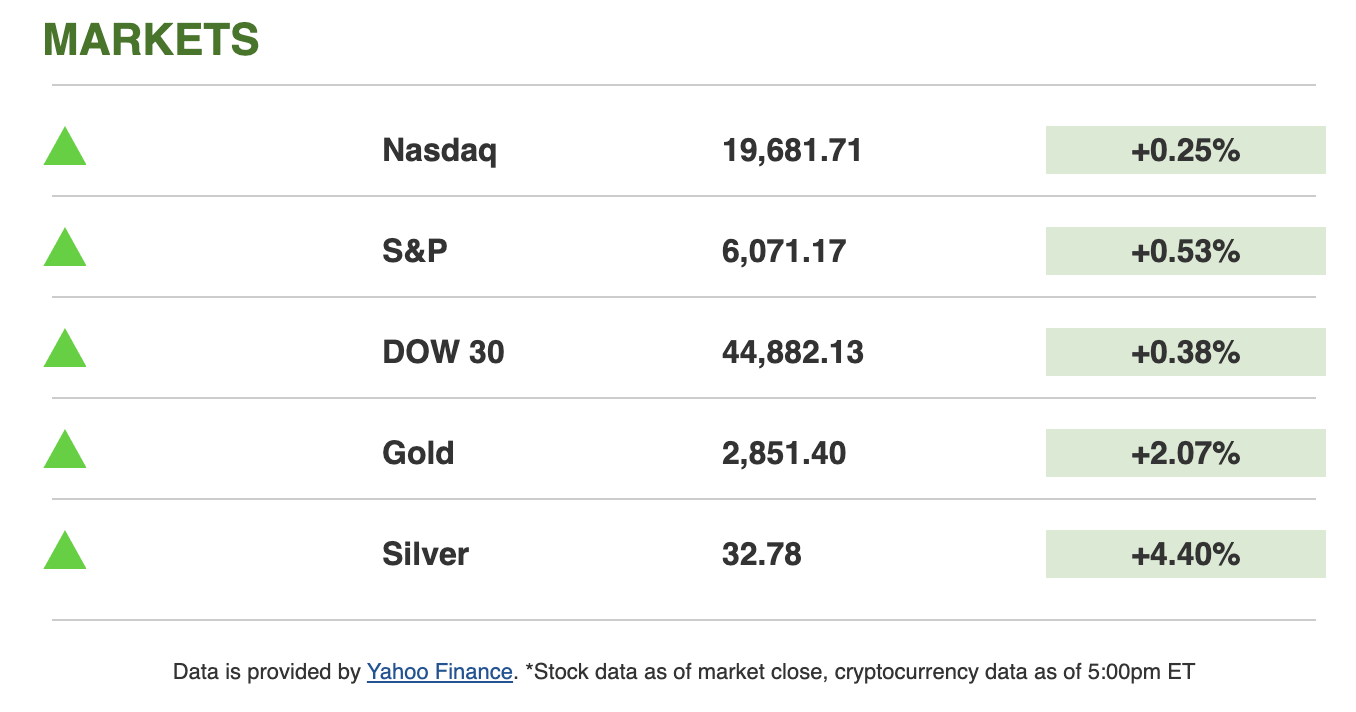
MARKET HEADLINES
📉 DeepSeek’s AI breakthrough shook momentum stocks, prompting JPMorgan to highlight new investment opportunities in financials, tech, and cruise sectors.
📦 UPS stock fell despite beating earnings expectations, as weak 2025 guidance disappointed investors amid economic concerns.
🖥️ Nvidia shares dropped further as fears over cheaper AI alternatives and potential U.S. chip export restrictions overshadowed strong AI spending by Microsoft and Meta.
💰 Bitcoin and other cryptocurrencies rose as investors shrugged off the Fed’s hawkish stance, focusing on Trump’s pro-crypto policies.
🌏 DeepSeek’s AI success reshapes U.S.-China tech rivalry, highlighting China’s growing innovation despite U.S. export restrictions.
Big Tech Burns Billions, but Nvidia Still Takes a Hit
Microsoft and Meta just dumped nearly $40 billion into AI, yet somehow, Nvidia’s stock still tanked because a Chinese startup claims they can do AI better and cheaper.
Investors are now wondering if Nvidia’s gold mine of overpriced chips is about to dry up.
Meanwhile, Microsoft’s earnings flopped, sending its stock down 5%, while Meta keeps raking in ad cash and lighting billions on fire, with Zuckerberg calling it a “strategic advantage” (translation: we have no idea if this will work).
With AI supposedly getting more efficient, these tech giants might just be throwing money into a black hole. But hey, what’s a few billion among friends?
STOCKS TO WATCH
↗️ Meta Platforms: The parent company of Facebook and Instagram reported record-breaking quarterly revenue. Additionally, the company reached a $25 million settlement to resolve a lawsuit filed by President Trump in 2021 after his social media accounts were suspended. Shares climbed about 2% before the market opened.
↘️ Microsoft: Despite surpassing expectations for net income and revenue, the tech giant saw a slowdown in the growth of its flagship cloud-computing segment. This led to a drop of approximately 3.5% in premarket trading.
↗️ Tesla: The electric vehicle maker posted a quarterly profit that fell short of expectations, but CEO Elon Musk doubled down on his belief that Tesla will become the world’s most valuable company, driven by advances in robotics and self-driving technology. Shares gained ground in premarket trading.
↘️ American Airlines: A tragic midair collision between an American-operated Bombardier jet and a military helicopter resulted in fatalities after the jet crashed into the Potomac River near D.C.’s Reagan Airport, according to Texas Senator Ted Cruz. Shares declined by around 3% before the bell.
🔎 Upcoming Earnings: Reports are expected early Thursday from Blackstone, Caterpillar, Mastercard, and UPS.
This Day in the Markets
📉 On this day in 1917, the U.S. stock market experienced a sharp decline of nearly 2.5% as investors reacted to growing fears that America would soon enter World War I, driven by Germany’s announcement of unrestricted submarine warfare against neutral and Allied ships, a move that heightened geopolitical tensions and signaled a potential escalation of the global conflict, leading to widespread uncertainty and selling pressure on Wall Street.
STOCK PICK OF THE WEEK
Brownstone Research
Larry Benedict went 20 years on Wall Street without a single losing year…
His former hedge fund, Banyan Capital, was ranked in the top 1% in the entire world….
And he’s one of the few dozen people to earn the label “Market Wizard” (along with Ray Dalio and Paul Tudor Jones).
And he’s proud to say that I helped generate hundreds of millions over the years for his hedge fund clients in every kind of market (including $95 million during the ’08 crash).
But his strategy flies directly in the face of everything your financial planner will tell you.
It has nothing to do with buy-and-hold.
It has nothing to do with diversifying your portfolio.
And it has nothing to do with tech stocks.
It’s easy to implement, and you don’t have to go out of your comfort zone to get started.
He recently aired a video explaining exactly how to do it.
You could have the chance to start making more money for your retirement right now.
ECONOMY
Europe’s Economy Is Tanking—And, Of Course, They’re Blaming Trump

The eurozone is barely treading water, with zero growth last quarter and rising unemployment—but instead of owning up to their failed policies, they’re panicking over potential U.S. tariffs from President Trump.
France’s economy is shrinking, Germany is in its second year of contraction, and Italy is flatlining, yet somehow, the real problem is that Trump might make them pay fair trade rates.
Meanwhile, despite falling inflation and lower interest rates, European consumers are still too nervous to spend, and businesses won’t invest.
Maybe that has something to do with crushing taxes, overregulation, and decades of socialist experiments?
But no, let’s just blame the one guy in America trying to put U.S. workers first.
If Europe spent half as much time fixing its own economy as it does whining about Trump, they might actually get somewhere.
ECONOMY HEADLINES
💰 Bitcoin and other cryptocurrencies rose despite the Fed holding rates steady, as investors focused on Trump’s pro-crypto stance and regulatory changes.
📈 Investors have embraced Trump’s market-friendly policies, but his aggressive spending cuts and executive orders could create long-term economic uncertainty.
🏦 The Federal Reserve paused rate cuts, signaling that inflation must ease further before additional reductions, while uncertainty surrounding Trump’s policies looms.
📉 U.S. economic growth slowed in late 2024 due to a widening trade deficit, though strong consumer spending helped maintain stability.
⚖️ The White House rescinded its controversial federal funding freeze memo, but legal battles continue as states challenge Trump’s spending restrictions.
BUSINESS
Toyota Still #1—Because Hybrids Actually Work
Toyota held onto its title as the world’s top automaker, even though its sales dipped 3.7% last year.
Why? Because unlike other car companies betting the farm on electric vehicles that nobody wants, Toyota wisely stuck to hybrids—giving consumers an option that doesn’t leave them stranded searching for a charger.
U.S. and European buyers embraced this common-sense approach, but China, the world’s biggest car market, wasn’t as kind.
Meanwhile, Volkswagen’s sales also fell, while China’s BYD surged with a 41% sales increase (because shocker—China buys from China).
Toyota’s “multipathway” strategy, offering hybrids alongside traditional engines, is proving smarter than the EV pipe dreams pushed by regulators.
Maybe the rest of the industry should take notes before they go bankrupt.
RETIREMENT
Tech Stocks Tank—Maybe Don’t Bet Your Retirement on Silicon Valley

If Monday’s market meltdown taught us anything, it’s that putting your entire 401(k) in Big Tech might not be the best retirement strategy.
The Nasdaq fell 3.1%, Nvidia crashed 17%, and all because a Chinese startup figured out how to do AI cheaper.
With tech stocks making up 35% of the S&P 500, plenty of retirement accounts felt the sting.
Experts are now reminding investors that diversification isn’t just a buzzword—it’s survival.
Value stocks, dividend payers, and equal-weighted funds can help keep your nest egg from cracking when the next overhyped tech bubble bursts.
Whether this was a one-day scare or the start of something bigger, now’s the time to rethink your retirement portfolio before Wall Street’s AI obsession drains it dry.
Trivia
Which industry in the U.S. generates over $2 trillion annually, making it one of the largest contributors to the economy while employing nearly 10% of the nation’s workforce?
A. Finance & Insurance
B. Entertainment & Media
C. Construction
D. Hospitality & Tourism
E. Agriculture
Scroll for the answer
TAXES
Uncle Sam’s 2025 Tax Changes—What’s Up, What’s Staying the Same
Good news: tax brackets are shifting up slightly to account for inflation, meaning you might keep a few extra dollars from the IRS’s grasp.
Bad news? Plenty of taxes aren’t budging.
The cap on state and local tax deductions is still locked at $10,000, and the 3.8% surtax on investment income isn’t going anywhere.
On the retirement front, 401(k) contribution limits are increasing to $23,500 (with extra perks for older savers), and IRA limits are up slightly to $7,000.
Estate and gift tax exclusions are also rising, which is great if you’re planning to pass on a fortune—just don’t expect D.C. to leave that alone for long.
With tax season upon us, now’s the time to strategize before Congress finds new ways to nickel-and-dime you.
Because let’s be honest, they always do.
Answer
Which industry in the U.S. generates over $2 trillion annually, making it one of the largest contributors to the economy while employing nearly 10% of the nation’s workforce?
D. Hospitality & Tourism
The hospitality and tourism industry is a major driver of the U.S. economy, generating over $2 trillion in economic output annually and employing nearly 10% of the American workforce.
This sector includes hotels, restaurants, travel services, and entertainment venues, attracting millions of domestic and international visitors each year.
The industry’s growth is fueled by evolving consumer preferences, business travel, and the increasing popularity of experiential tourism.