Investors rotate out as uncertainty builds

Dear Friend,
Well, 2026 came in swinging—tech stocks hit snooze while energy and utilities finally got their five minutes of fame.
The Nasdaq’s on a losing streak, Tesla’s deliveries are tanking, and silver is apparently trying out for gold’s job.
Meanwhile, Trump’s eyeing a Fed shake-up that has Wall Street sweating through its Patagonia vests—and Meta just bought a “neutral” AI startup with a suspiciously Beijing-flavored past.
Keep reading this edition of the Everlasting Wealth Insider Report to find out what’s really moving markets this week.
Jeremy Blossom
Editor in Chief, Everlasting Wealth
MARKETS
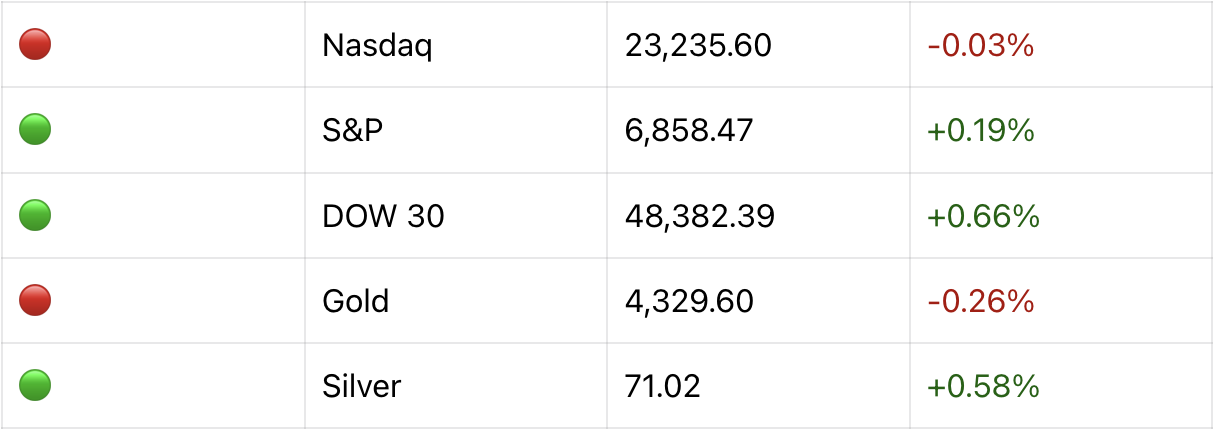
MARKET HEADLINES
🥈 Silver’s massive 2025 rally, outpacing oil and reaching rare historical ratios, has experts divided over whether it’s a bubble or a new monetary haven.
⚡ BYD surpassed Tesla in all-electric vehicle sales for 2025, becoming the new global EV leader thanks to rapid growth, affordability, and exports.
📈 The S&P 500 has a 50/50 chance of extending its three-year winning streak into 2026, with bulls betting on AI-driven earnings growth and bears warning of stretched valuations.
📉 AppLovin stock fell for a seventh straight day despite a stellar 108% gain in 2025, as investors lock in profits and volatility returns to the high-flying ad-tech name.
🌍 Markets may be underestimating a stronger-than-expected global economic rebound in 2026, which could reignite inflation and challenge the current soft-landing narrative.
🏥 Healthcare and banking stocks like CVS, AstraZeneca, and Citigroup surged in 2025, and analysts see their strong earnings and strategic pivots continuing to fuel gains in 2026.
🛢️ Sable Offshore shares jumped 29% after a court allowed its controversial California pipeline restart to proceed despite environmental concerns.
🧮 After a three-year rally, history suggests the S&P 500 could still rise in 2026, but the odds of a continued bull run are narrowing with risk of late-cycle downturns.
⚠️ Despite a calm end to 2025, January could jolt markets with volatility as earnings season and Fed decisions test lofty valuations and investor optimism.
🇬🇧 The FTSE 100 hit a record 10,000, outpacing the S&P 500 in 2025 with strength from silver miners and defensive sectors—despite little help from AI hype.
Tech Trips, Energy Sprints – Wall Street Rings in 2026 with a Plot Twist

So, the stock market rang in 2026 by flipping the script—big tech took a nap while energy and utility stocks finally got their moment in the sun.
After years of hearing how AI would basically walk our dogs and cook our dinners, investors are now wondering if these tech companies actually make money, or if they’re just playing hot potato with each other’s stock.
The Nasdaq fell again (five days in a row—bravo), while the Dow strutted higher thanks to old-school names like Boeing and Caterpillar.
Meanwhile, Tesla’s stock slid like a greased bowling ball after reporting yet another drop in deliveries.
Guess all those Cybertrucks aren’t exactly flying off the shelves.
Even Amazon and Meta got smacked around, while Nvidia and Micron managed to keep tech from fully collapsing.
Apparently, silver’s trying to be the new gold, which just had its worst week since 2021. Ouch.
AI’s still the buzzword, but now folks are starting to ask if it’s just more hype than help.
Markets seem stuck in “wait-and-see” mode—which basically means Wall Street’s best strategy right now is “fingers crossed.”
STOCKS 2 WATCH
↗️ Baidu (BIDU): The Chinese tech firm surged 15% after its chip division filed for a public listing, riding the wave of growing investor interest in AI-driven IPOs.
↗️ Orsted (DK:ORSTED): Shares in the Danish renewable energy company climbed up to 5% following news that its U.S. joint venture plans legal action to challenge a federal pause on offshore wind development.
↘️ Tesla (TSLA): The EV giant slid 2.6% after revealing an 8.6% decline in annual deliveries, ceding the global EV crown to China’s BYD.
↗️ Nio (NIO), Li Auto (LI): The Chinese electric vehicle manufacturers saw their U.S.-listed shares rise around 1% each thanks to robust delivery numbers that outpaced industry rivals.
↗️ Wayfair (W), RH (RH), Williams-Sonoma (WSM): Furniture retailer stocks rallied after a one-year delay was announced on tariffs affecting items like kitchen cabinets and upholstered furniture, thanks to a move by President Trump.
Fact of the Week
One sneaky way investors “read” the U.S. economy is by watching freight rail and trucking activity—because when factories ramp up and stores restock, you’ll often see it first in packed intermodal containers and rising shipping volumes, turning America’s supply chain into a real-time economic mood ring long before many official reports hit the headlines.
ECONOMY
Trump Eyes the Fed, Wall Street Pretends Not to Sweat (But Pass the Tums)
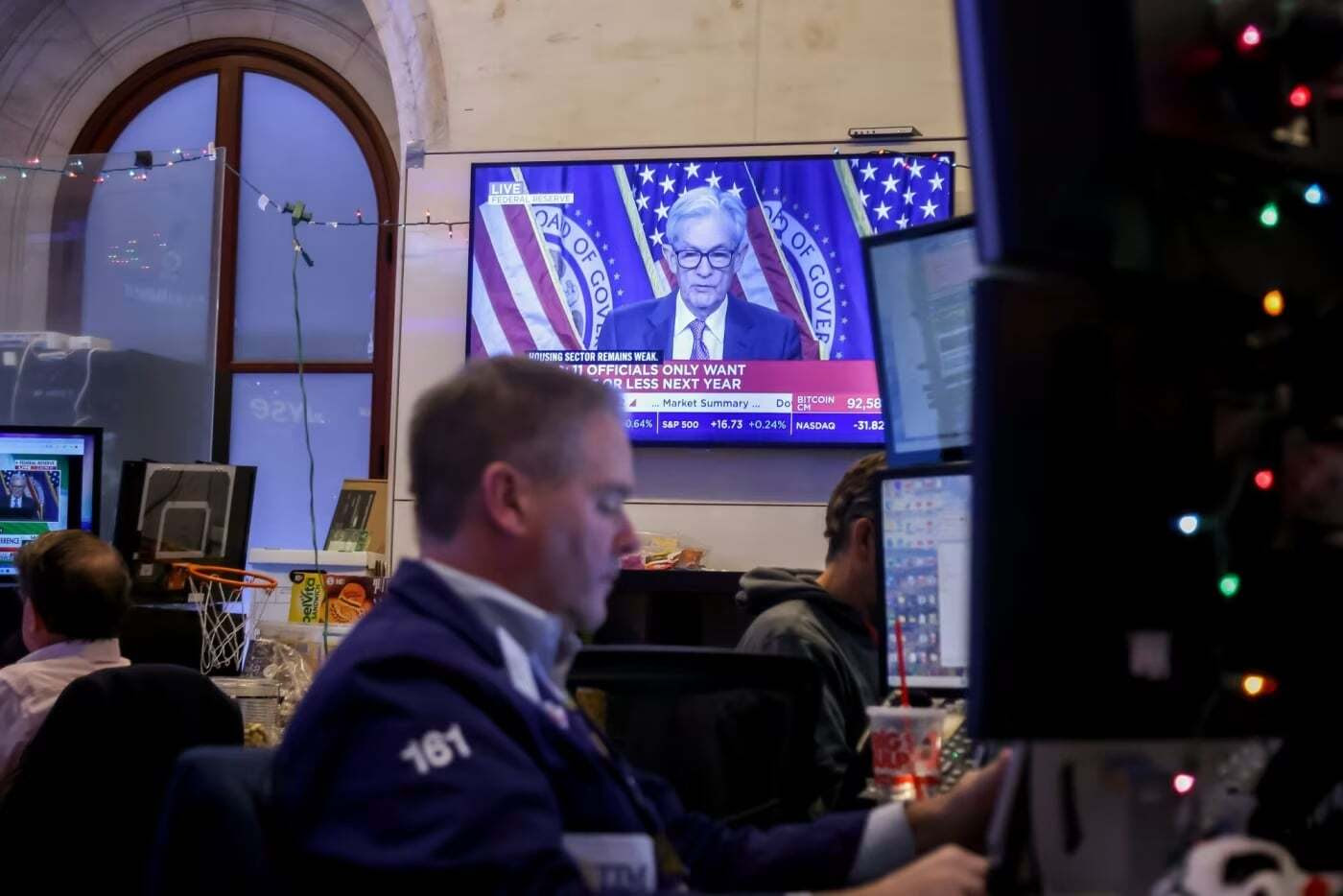
Markets are playing it cool while Trump lines up his next Fed chair pick, but behind the scenes, Wall Street’s clenching up like it just saw Elizabeth Warren eyeing their tax returns.
Trump wants someone who’ll actually cut rates (imagine that—someone who works for Americans), and he’s made it clear the next chair better not be a Powell-style squish.
The Fed’s supposed to be “independent,” but let’s not kid ourselves—it’s been a cartel of academic elites steering us into inflation potholes for years.
Investors are nervous the next Fed might actually have a backbone and a Trump-appointed majority, which could shake up the “consensus” club and send long-term rates spinning.
Apparently, if Powell steps down or Lisa Cook gets the boot for some sketchy mortgage fibbing, the power balance could shift—cue Wall Street hand-wringing.
Even with this looming shake-up, markets haven’t totally freaked, mostly because folks think a weaker economy will force everyone to agree on more cuts anyway.
Basically, if Trump gets his way, rates are going down—and for once, not just to save Wall Street’s bacon.
And of course, investors only care if the new Fed chair sounds “smart” while lowering rates, as if tone matters more than results. Typical.
ECONOMIC HEADLINES
📉 Tariffs dampened U.S. hiring in 2025 without fueling inflation, but easing policy uncertainty in 2026 could reignite job growth and boost business confidence.
🏛️ Criticizing one-size-fits-all regulation, Amar Bhidé argues for a more flexible financial system that empowers real economic enterprise over performative stock market rituals.
🛋️ Furniture stocks rallied after Trump delayed tariff hikes, giving the import-heavy sector crucial breathing room amid already soft consumer demand.
🤖 China’s AI boom kicked off 2026 with a bang as Biren’s IPO soared and Baidu surged, reviving global AI hype and lifting U.S. tech stocks in early-year trading.
🪫 The S&P 500 may disappoint in 2026, with election-year trends, fading AI enthusiasm, and already-priced-in fiscal support setting the stage for a flat or modestly negative year.
🏠 Mortgage rates ended 2025 at a 14-month low of 6.15%, offering hope to prospective homebuyers and signaling potential relief for the sluggish housing market in 2026.
⚖️ A divided Federal Reserve, facing a leadership transition and inflation uncertainty, may shape market performance in 2026 as rate cut decisions remain finely balanced.
🧩 China’s low-profile “invisible” stimulus, relying on local governments and SOEs rather than headline-grabbing packages, aims to stabilize growth without reigniting excesses.
🇪🇺 Despite internal discord, the EU managed modest wins in 2025 on Ukraine and trade, maintaining enough cohesion to keep investors optimistic heading into 2026.
🚂 Union Pacific and Norfolk Southern seek to merge and shift two million truckloads annually to rail, promising public benefits and $2 billion in added revenue amid stagnant freight volumes.
Trivia
When a company is announced as being added to the S&P 500, what market reaction is most commonly observed in the short term—and what’s the main reason behind it?
A. The stock usually falls because index funds sell it to reduce concentration risk
B. The stock often rises because index funds and benchmarked managers are forced to buy to match the index
C. The stock is halted for several days because S&P 500 membership requires new SEC filings
D. The stock usually drops because its valuation must be “reset” to the S&P 500 average
E. The stock is required to do a stock split to meet S&P 500 liquidity rules
Scroll for the answer
BUSINESS
Meta Buys a “Not-Chinese-Anymore” AI Startup—Totally Not Sketchy, Promise!

Meta just dropped $2.5 billion on a supposedly “neutral” AI startup called Manus, which just so happens to have been born in China and raised on a diet of Tencent and WeChat.
But don’t worry, they swear they’ve cut ties with their Chinese roots by moving to Singapore and hiring some lawyers.
Crisis averted! The Biden admin isn’t throwing a fit this time, probably because Manus checked the right boxes on some export control bingo card. D.C.’s acting like this proves our regulations are working, while China’s over there fuming that another homegrown AI project just got swallowed by Zuckerberg & Co.
This feels less like free-market innovation and more like laundering tech origins so U.S. companies can pretend they’re not funding CCP brainchildren.
But hey, at least Meta gets a shiny new AI toy for WhatsApp and Instagram—because what the world really needs is even creepier smart glasses with Beijing-engineered brains.
Apparently, Manus turned down Alibaba and Chinese city governments to avoid raising eyebrows here. So congrats to them for scrubbing the red off just enough to cash in on Silicon Valley gold.
Good to know all it takes is a Singapore address and a decent PR team to fly under the radar these days.
Ah yes, nothing says “America First” like funding our tech future with Chinese leftovers.
Answer
When a company is announced as being added to the S&P 500, what market reaction is most commonly observed in the short term—and what’s the main reason behind it?
B. The stock often rises because index funds and benchmarked managers are forced to buy to match the index
The “index inclusion effect” happens because once S&P announces an addition, trillions of dollars tracking or hugging the S&P 500 (index funds, ETFs, and benchmarked active managers) must buy the stock—often around the effective date—creating a sudden, price-insensitive surge in demand that can push the price up even if nothing about the company’s fundamentals changed overnight.