Record small-cap gains clash with rising yields and weak data

Dear Friend,
Wall Street’s putting on its best interpretive dance—some stocks up, some down, and no one has a clue what it means.
Small-caps are suddenly the prom kings (go Russell 2000), everyone’s praying the Fed finally chills out, and bond yields in Japan just time-traveled from the flip phone era.
Oh, and Netflix just bought half of Hollywood for $72B, because apparently owning your watchlist and your soul is the new business model.
Here’s what else you need to know in this week’s edition of the Everlasting Wealth Insider Report.
Jeremy Blossom
Editor in Chief, Everlasting Wealth
MARKETS
MARKET HEADLINES
📈 Nvidia stock edged higher as Foxconn’s strong AI server sales offset HPE’s slowdown, signaling robust demand for AI chips despite mixed signals from hardware partners.
💬 Twilio shares have surged 20% as the company grows earnings faster than peers, driven by strong customer retention, AI integration, and margin expansion.
🔍 Markets remained cautious ahead of the Fed’s preferred inflation report, which could clarify interest rate direction and impact investor sentiment heading into next week’s policy decision.
💸 SoFi’s stock fell nearly 6% after announcing a $1.5 billion share sale, despite strong year-to-date gains, as investors reacted to potential dilution.
☁️ CoreWeave and other ‘neocloud’ providers face high risks and debt, but offer massive AI growth potential, attracting attention as traditional hyperscalers run short on capacity.
🛠️ Samsara beat earnings expectations with strong ARR growth and record customer wins, but its stock dipped slightly as investors looked for an even stronger outlook.
🤖 Salesforce delivered strong profits and rising AI revenue, boosting its stock and potentially ending its three-quarter losing streak despite a slight revenue miss.
📊 Intel’s stock is breaking out of a long-term technical base, reflecting growing investor optimism about its turnaround and AI-fueled future.
🧠 Micron is exiting its consumer memory business to prioritize AI-focused chips like HBM, but its stock fell amid broader concerns over a peak in AI-related demand.
⚖️ Despite bullish 2026 forecasts, risks like slowing global growth, sticky inflation, rising debt, and a potential AI bubble burst could derail market optimism.
Wall Street’s Latest Mood Swing: Small Stocks Party While the Dow Naps

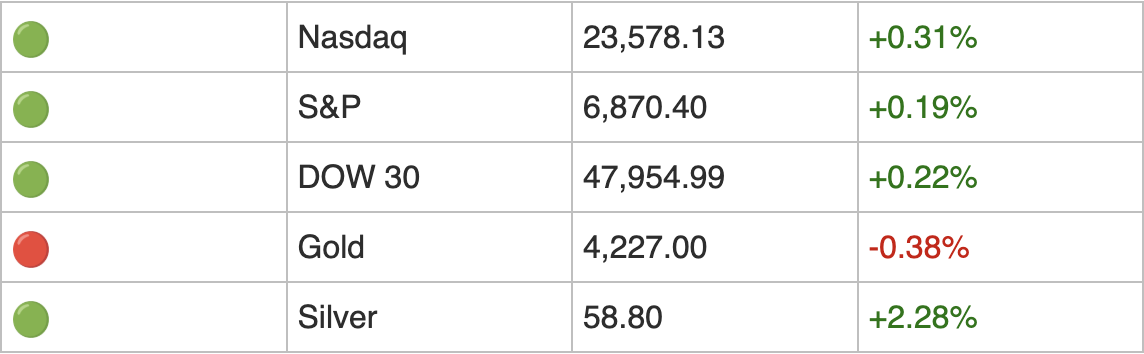
Wall Street did its usual dance yesterday—some stocks up, some down, and no one is really sure what the economy’s up to.
The Dow dipped a little, the S&P and Nasdaq tiptoed higher, but the little guys—small-cap stocks—decided it was their time to shine, with the Russell 2000 hitting a record high.
Apparently, investors are betting the Fed will finally take its foot off our necks and cut interest rates next week.
Meanwhile, bond yields are creeping up here and in Japan, where they haven’t seen numbers this high since flip phones were cool.
Tech stocks did their thing—Meta jumped after laying off more metaverse folks (because who needs virtual reality when actual reality is already a circus?).
Salesforce is high on its own AI supply and raised its guidance.
And just in time for the holidays, Americans are officially shopping like it’s 2008 again—Dollar General’s booming, Kroger’s hurting, and folks are clearly hunting for bargains.
Oh, and jobless claims dropped to a 3-year low… during a week we weren’t even sure the government was open. Totally makes sense, right?
STOCKS 2 WATCH
↗️ Ulta Beauty: The beauty retailer boosted its annual revenue and profit forecasts after a strong quarterly performance, sending shares up 5.5% in after-hours trading.
↘️ SoFi Technologies: After announcing a $1.5 billion public share offering, the fintech firm’s stock slumped 7% ahead of the market open.
↘️ Hewlett Packard Enterprise: The cloud and server company reported weaker-than-expected revenue due to AI deployment delays among clients. Shares dropped nearly 9% premarket.
↗️ Warner Bros. Discovery: Shares climbed over 3% in early trading after entering exclusive talks to sell its studios and HBO Max business to Netflix.
↘️ Cloudflare: The cybersecurity company saw its stock decline before the open amid fresh reports of another service outage.
↘️ DocuSign: Despite raising its full-year revenue forecast and posting strong results fueled by subscription growth, shares of the e-signature company fell 5.5% in premarket trading.
🔎 Meta Platforms: Shares advanced Thursday following reports of internal restructuring away from the metaverse toward AI-powered wearable tech, signaling a potential strategic shift.
Fact of the Week
Nearly a third of U.S. inflation (CPI) is “shelter,” and about a quarter of the whole index is Owners’ Equivalent Rent—an imputed number based on what homeowners think their place would rent for, not their actual mortgage or home price—so housing’s slow-moving surveys can keep headline inflation high months after real-time rents cool, baffling markets and the Fed alike.
ECONOMY
Manufacturing Slows, But Tariffs Are Doing the Heavy Lifting for America First

Manufacturing dipped again in November—ninth month in a row—but don’t buy the media spin blaming Trump’s tariffs like it’s some kind of economic apocalypse.
The ISM index came in just below 50, which means we’re still in a bit of a slump, but let’s be honest: this is what happens when you stop letting China walk all over us.
Tariffs are making companies rethink their supply chains, and yeah, it’s bumpy—but long term, it’s about bringing jobs home, not outsourcing everything to Beijing.
Some industries are feeling the pinch—like apparel and transportation—but that’s what restructuring looks like when you put America first.
Companies are holding off on hiring because they’re adjusting to the new normal—fair trade, not free-for-all trade.
And while some folks are wringing their hands over “uncertainty,” others are quietly optimistic that lower rates and tax incentives will give things a boost next year.
It’s a little pain now for a whole lot more independence down the road.
Economic Headlines
🕶️ Meta is shifting funding from the metaverse to AI-powered wearables like smart glasses, posing a growing competitive threat to Apple’s smartphone dominance.
🧾 Costco, Revlon, and dozens of other firms are suing for tariff refunds ahead of a key court deadline, potentially securing billions if Trump’s levies are struck down.
👵 A new tax law boosts after-tax income for retirees with a $6,000 senior deduction and extended low tax rates, offering strategic savings and planning opportunities.
🛒 Despite strong quarterly sales growth and e-commerce gains, Costco’s stock dipped ahead of its earnings report as investors took profits.
📉 Weak November job data, especially among small businesses, is increasing pressure on the Fed to cut interest rates at its upcoming meeting.
🏗️ Wall Street’s growing inequality is taking a capital-K shape as upper-income households drive consumption while middle-income Americans struggle, reshaping market risks and opportunities.
⚖️ Meta shares rose on news of metaverse budget cuts, even as the EU opened an antitrust probe into WhatsApp’s AI policies.
🍒 The ‘Pac-Man economy’ shows that while top earners drive spending, the wealth gap hasn’t widened dramatically post-pandemic—though inflation and tariffs may change that.
🏛️ Trump is expected to nominate Kevin Hassett as Fed Chair, raising hopes for rate cuts but sparking concerns over central bank independence and inflation risks.
🎅 Retail investor optimism and strong earnings have positioned the S&P 500 for a classic December rally, possibly pushing it past 7000 if rate cuts materialize.
Trivia
Which single factor significantly transformed the U.S. economy during the late 20th century, leading to the rise of the information age?
A. The Dot-Com Boom
B. Advancements in Semiconductor Technology
C. Deregulation of Telecommunications
D. Expansion of the Internet
Scroll for the answer
BUSINESS
Netflix Buys Warner Bros—Because Apparently Owning the Internet Wasn’t Enough

Well, Netflix just dropped $72 billion to buy Warner Bros. after it splits off HBO Max and its studios—because nothing says “competition” like one company owning half of Hollywood.
Paramount and Comcast tried to snag the deal too, but Netflix came in swinging with a mostly cash offer, like a kid buying the entire candy store with a blank check.
This mega-merger is supposed to give us “more of what we love,” which I guess means 18 more versions of Love Is Blind and a few more woke Harry Potter spin-offs.
Naturally, D.C. is already side-eyeing the whole thing, worried that Netflix + HBO Max might equal one giant streaming monopoly.
But hey, when has Congress ever been good at stopping tech giants from eating everything in sight?
Paramount’s throwing a fit, crying that the deal was “rigged,” which sounds a lot like sour grapes from the kids who showed up late to the bidding war.
Still, get ready for a whole new kind of Hollywood—one where Netflix decides what you watch, when you watch, and probably how you think about it too. Can’t wait.
Answer
Which single factor significantly transformed the U.S. economy during the late 20th century, leading to the rise of the information age?
B. Advancements in Semiconductor Technology
While all the options contributed to the rise of the information age, advancements in semiconductor technology served as the foundation.
Semiconductors powered the creation of computers, mobile devices, and other digital tools, enabling rapid technological progress.
This innovation not only revolutionized industries but also paved the way for the Dot-Com Boom and the expansion of the Internet.