
Dear Friend,
Monday hit like a financial hurricane—$1 trillion wiped out, thanks to China’s DeepSeek stealing Nvidia’s AI thunder.
Wall Street panicked, and Nvidia’s $600 billion nosedive made history.
Meanwhile, Trump’s calling for tariffs (again), which could keep inflation lingering like a bad houseguest, complicating the Fed’s plans.
On the corporate front, Starbucks is brewing a turnaround, but investors aren’t sure if the latte is half full or half empty.
And with tax season bringing new rules and penalties, you’ll want to know what’s coming before the IRS does.
Buckle up—this edition of the Everlasting Wealth Insider Report has it all.
Jeremy Blossom
Editor in Chief, Everlasting Wealth
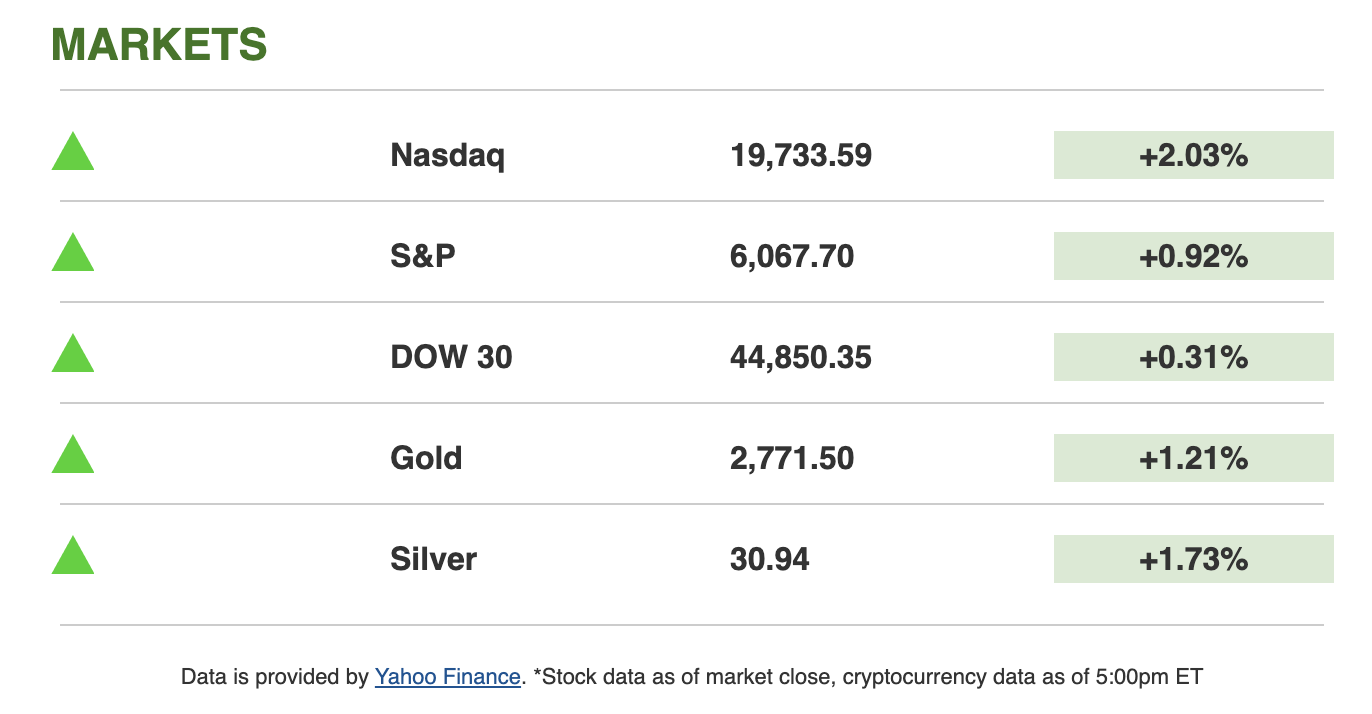
MARKET HEADLINES
📈 Nvidia shares rebounded 4.8% in premarket trading after a historic $593 billion drop, as analysts argued concerns about DeepSeek AI’s cheaper competition are overblown due to its ongoing reliance on Nvidia’s powerful chips for model inference.
💰 Cryptocurrencies surged, with Bitcoin crossing $100,000 and XRP gaining 10%, as investors returned to riskier assets following Monday’s tech rout, driven by hopes for market stabilization and speculation about progress in national crypto reserves.
🎰 Rising inflation has driven investors to riskier “lottery stocks,” which tend to spike during inflationary periods as people chase outsized gains to offset purchasing power loss, though these stocks often underperform in the long term.
📊 The Dow showed resilience, climbing nearly 300 points as defensive sectors like healthcare and consumer staples outperformed, providing stability on a day when tech-heavy indexes suffered major losses due to AI-related sell-offs.
🔧 The U.S. Steel-Nippon Steel merger faces new complications as an activist investor pushes for leadership changes, opposing the stalled deal over national security concerns and proposing a shift toward a domestic strategic focus.
China’s AI Bombshell Leaves Wall Street Reeling

Monday was a financial bloodbath—$1 trillion evaporated from the market as Nvidia, the AI golden child, got steamrolled by China’s DeepSeek.
This scrappy upstart dropped an AI model that’s just as sharp but way cheaper to run, sending Nvidia’s stock into a $600 billion nosedive—the biggest one-day loss ever.
Investors panicked, tech stocks tanked, and Wall Street looked like it had been hit by a truck.
Meanwhile, Nvidia is doing its best “everything’s fine” routine, insisting we’ll still need their chips, but DeepSeek just proved otherwise.
Oh, and did I mention it’s a Chinese company?
Trump called it a “wake-up call” for U.S. tech, but if this doesn’t get Silicon Valley moving, nothing will.
Looks like Beijing’s playing chess while we’re over here playing checkers—and losing.
STOCKS TO WATCH
↗️ Vistra, Talen, Constellation: Power producers rebounded slightly in premarket trading after Monday’s steep losses, driven by concerns over reduced AI-driven power demand.
↗️ Nvidia, Broadcom: Chipmakers experienced a premarket recovery after taking a hit from the DeepSeek effect, though they still traded below Friday’s closing prices.
↗️ Brown & Brown: The insurance broker surged approximately 5% before the bell, following its better-than-expected quarterly revenue and profit results.
↘️ Crane: The industrial-products manufacturer saw its shares tumble over 5% in premarket trading after issuing a 2025 earnings forecast that fell below analyst expectations.
🔎 General Motors: Set to release its earnings this morning, while Starbucks will report after market close.
🔎 Boeing, Lockheed Martin, RTX: Aerospace and defense companies are scheduled to report before the bell, with Boeing already flagging a near-$4 billion quarterly loss.
This Day in the Markets
📈 On this day in 2021, Robinhood restricted trading of GameStop, AMC, and other stocks after a Reddit-fueled trading frenzy sent their prices soaring. The move, aimed at managing volatility and clearinghouse requirements, sparked backlash from retail investors, lawmakers, and regulators, who accused the platform of favoring institutional investors.
STOCK PICK OF THE WEEK
Weiss Research
Thanks to Nvidia’s continued AI dominance and reflecting its growth potential
Bank of America recently made a huge announcement.
Analysts there are raising their price target for Nvidia to $190.
That’s nearly a third higher than its current price, which just reached a record high.
That means that, even though Nvidia has exploded as much as 198% in the last year…
Even though it was the S&P 500’s best performing stock in 2023 with a 239% gain…
And even though it’s shot up 749% since ChatGPT signaled the start of this AI boom at the end of 2022…
We believe Nvidia still has plenty of room to explode and dominate AI even more.
And it’s not the only company that could benefit from the next stage of this AI revolution.
We’re looking at three companies working closely with Nvidia that could now see their own stocks follow a similar path thanks to AI’s continued explosion.
See why this Nvidia boom is just beginning right away.
ECONOMY
Tariff Talks Add a New Challenge to the Fed’s Inflation Fight

Trump’s renewed tariff proposals are creating a tricky situation for the Fed, as they could push prices higher and fuel inflation expectations.
After years of pandemic-driven inflation, businesses, workers, and landlords have grown more accustomed to passing along rising costs, and tariffs could reinforce that trend.
The Fed, working to bring inflation down to its 2% target, is concerned that even the perception of persistent price increases could complicate their job.
If tariffs are rolled out in waves across different goods and countries, it may be harder for the Fed to determine whether inflation is tied to trade policies or broader economic forces.
Either way, the central bank may need to hold interest rates higher for longer to keep inflation under control, adding another layer of complexity to an already delicate economic landscape.
ECONOMY HEADLINES
📊 Consumer complaints about “debanking,” or account closures by banks labeling customers as “high risk,” are rising, with President Trump spotlighting the issue and proposing measures to ensure fair banking access amid concerns over political bias and regulatory pressures.
🏡 Home prices continued to climb in 2024 despite high mortgage rates, with economists predicting slower gains in 2025 due to limited inventory and strong demand, though new-home prices have slightly decreased, offering opportunities for buyers.
🌍 U.S. liquefied natural gas (LNG) exports are set to grow significantly despite climate concerns, with research showing minimal global emissions impact and increasing emphasis on reducing methane leakage to maintain competitiveness in an evolving energy market.
🤖 China’s DeepSeek AI has sparked debate over U.S.-China tech competition, highlighting China’s shift from manufacturing to innovation and calling for the U.S. to learn from China’s approach rather than relying solely on export controls.
🛠️ DeepSeek’s emergence raises questions about the limits of U.S. export restrictions, as China’s cost-effective AI advancements challenge U.S. tech leadership and call for stronger public-private collaboration to stay competitive in the AI race.
BUSINESS
Starbucks Earnings Expected to Dip Amid Costly Turnaround Push
Starbucks is set to report a 26% drop in earnings as new CEO Brian Niccol rolls out an expensive turnaround plan to recapture the brand’s charm and efficiency.
Niccol, lured from Chipotle with a $96 million payday, is focused on shorter wait times, simpler menus, comfy seating, and handwritten names on cups to bring back that personal touch (even if your name is still spelled wrong).
These efforts require big investments, cutting into profits for now, but investors will be watching Tuesday’s earnings call for signs of improvement after a bumpy holiday season and tensions with union workers.
With the stock back near $100 and analysts setting a $105 price target, the hope is that Niccol’s plan to “make Starbucks great again” starts brewing results soon.
RETIREMENT
What It Takes to Stay in Your Home as You Age

Aging in place sounds great in theory, but it requires careful planning, both financially and logistically.
Many people want to stay in familiar surroundings, but home modifications like widening doorways or adding ramps can be costly, with nearly half of seniors saying their homes aren’t accessible.
Financial advisors encourage starting these conversations early—before retirement—to estimate costs, plan for care needs, and explore alternatives like condos or retirement homes.
Emotional attachments and past experiences often complicate the decision, and professionals like contractors or care specialists can provide objective assessments.
Still, even the best plans can fall apart if health needs escalate, as many seniors eventually require advanced care that can’t be handled at home.
The key is balancing emotional desires with financial realities to make aging in place as practical and safe as possible.
Trivia
Which sector of the U.S. economy is the largest employer, contributing over 15 million jobs and accounting for nearly 20% of the nation’s GDP?
A. Manufacturing
B. Retail
C. Healthcare
D. Technology
E. Agriculture
Scroll for the answer
TAXES
Tax season kicks off with a few changes that could impact your wallet.
First, online sellers beware: platforms like PayPal and eBay now issue 1099-Ks for sales over $5,000, meaning millions more Americans must report this income—even if it’s just clearing out the basement.
EV buyers who snagged the $7,500 tax credit must report it on their returns to confirm eligibility or risk clawbacks.
On the penalty front, gig workers especially are getting hit hard for underpayment, so adjust withholding or pay estimates on time to avoid the 7% penalty.
The IRS is also expanding its free filing options, including its Direct File service, now available in 25 states.
Plus, disaster relief filers can claim losses more easily thanks to relaxed rules, which could mean big refunds.
Finally, tax refunds may not come with savings bonds anymore, but splitting refunds between accounts like IRAs or savings is still an option.
Little tweaks, big impact—get filing!
Answer
Which sector of the U.S. economy is the largest employer, contributing over 15 million jobs and accounting for nearly 20% of the nation’s GDP?
C. Healthcare
The healthcare sector is the largest employer in the United States, employing over 15 million people across hospitals, clinics, research facilities, and related services.
It accounts for nearly 20% of the nation’s GDP, driven by advancements in medical technology, an aging population, and growing demand for healthcare services.
The sector not only provides essential services but also contributes significantly to innovation, education, and economic growth.