Rate cuts may be further away

Dear Friend,
The markets are sizzling like a July grill—record highs, big crypto wins, and meme stocks back from the dead.
But don’t let the sunshine fool you—tariffs are quietly creeping into prices, inflation’s ticking up, and Trump’s out here trying to redesign Coca-Cola. Yes, really.
Meanwhile, Netflix is winning overseas, Lucid’s diving into the robotaxi wars, and graphite just got slapped with a 160% tariff.
The EV crowd is panicking, but Elon? Still sleeping fine.
Keep reading this edition of the Everlasting Wealth Insider Report—because even in a bull market, there’s always a storm brewing somewhere.
Jeremy Blossom
Editor in Chief, Everlasting Wealth
MARKETS
MARKET HEADLINES
📈 Congress passed the GENIUS Act and the Clarity Act, signaling a regulatory turning point for cryptocurrencies, while Trump prepares to allow crypto in 401(k) plans, sending XRP and other altcoins soaring.
💼 Trump’s new tax law significantly benefits wealthy individuals and small businesses by expanding deductions, easing SALT limits for pass-throughs, and enhancing tax breaks for startup investors.
📉 Fed Governor Christopher Waller urged an immediate rate cut due to slowing growth and fading inflation, breaking with Powell and aligning more closely with Trump’s economic agenda.
🧲 MP Materials stock gained after securing Pentagon and Apple deals that guarantee pricing and demand, despite a large $650 million share sale and already steep year-to-date gains.
💸 Tariff-driven inflation ticked up slightly in June but bond markets remained calm, suggesting investors view the price pressures as temporary unless they become more persistent.
📊 Despite rising consumer prices linked to tariffs, bond markets signal that inflation will be short-lived, potentially setting the stage for Fed rate cuts later this year.
⚠️ After two patient deaths, Sarepta cut 500 jobs and scaled back its gene therapy pipeline to stay financially afloat, but Elevidys faces a black box FDA warning and an uncertain future.
🪙 The crypto industry scored a major win as Congress passed the GENIUS Act regulating stablecoins, but broader market legislation still faces a steep path in the Senate.
📈 Active bond funds like those from Hartford, Pimco, and Dodge & Cox are proving their worth in a high-yield, high-volatility environment by offering better returns and more flexibility than passive ETFs.
📉 Despite Trump’s aggressive trade threats and soaring tariff risks, markets have largely ignored the signals, which could embolden policy moves that ultimately threaten economic stability.
Summer Markets Are Sizzlin’ But Watch Out for a Storm

Markets are feeling like a July barbecue—hot and carefree—but don’t toss your umbrella just yet.
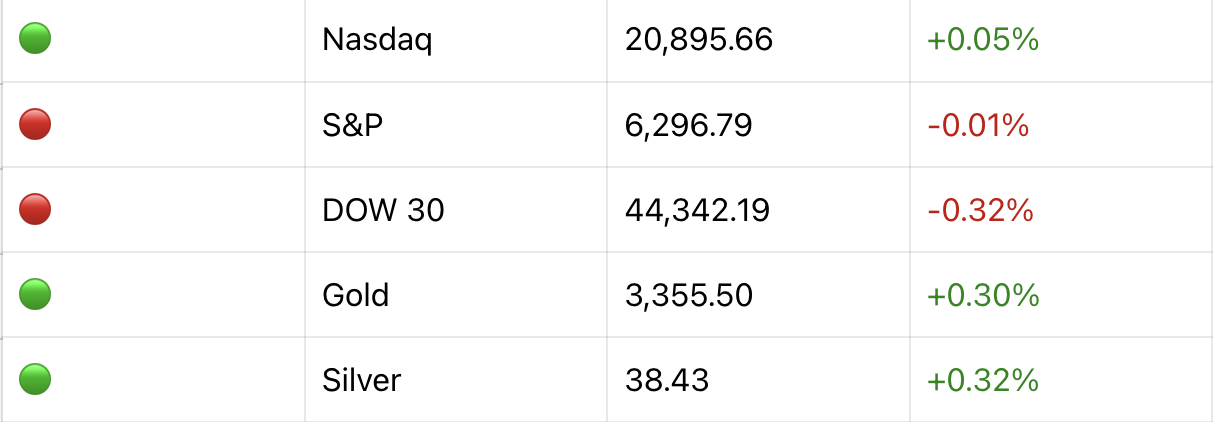
The S&P 500 just hit its ninth record high, fueled by strong consumer spending and talk of rate cuts.
But with Trump’s tariffs creeping into prices and meme stocks running wild again (Opendoor, anyone?), this rally’s got some storm clouds on the horizon.
Netflix is cashing in thanks to a weaker dollar and strong global subs, while crypto just scored big with the Genius Act—yep, stablecoins are now (almost) legit.
Oh, and Lucid’s jumping into the robotaxi race with Uber and Nuro, aiming straight at Waymo and Tesla.
Meanwhile, Trump’s latest idea? Get Coca-Cola to ditch corn syrup for cane sugar. Great—now tariffs might be driving up soda prices and your electric bill.
STOCKS 2 WATCH
↗️ BHP: The global mining giant reported all-time high annual output for both copper and iron ore. Shares in Australia rose 3% on the news.
↗️ Interactive Brokers: The online brokerage saw its stock climb 5% in premarket trading after it revealed double-digit growth in trading volumes during the last quarter.
↘️ GSK: Shares of the drugmaker dropped 6.5% in London following an FDA advisory panel’s rejection of approval for Blenrep, its treatment for blood cancer.
↗️ Norfolk Southern: Shares in the railroad company moved higher during extended trading after news broke that Union Pacific is exploring a potential acquisition.
🔎 American Express, Charles Schwab, 3M, SLB: These major companies are all slated to release their quarterly earnings Friday morning, with investors watching closely for sector-wide signals.
↗️ Burberry: Despite a decline in sales last quarter, the luxury fashion label performed better than feared. Shares advanced 4% in London.
↘️ Netflix: The streaming giant raised its full-year revenue and profit margin projections after beating earnings estimates—but shares still slipped slightly in premarket trading.
Fact of the Week
America’s tax system is powered by the Individual Master File, a database first coded in 1962—and it’s still running on lines of COBOL, a programming language older than the moon landing. Every tax season, the IRS processes billions of dollars on software that predates email, ATMs, and even floppy disks.
ECONOMY
Trump’s Tariffs Turn Up the Heat: Prices Rise, Jobs Tighten, and the Left Still Panics

Looks like the media finally caught up—Trump’s policies are actually doing something.
Inflation ticked up a bit in June, especially on stuff like furniture and clothing, and naturally the Wall Street crowd is acting like it’s DEFCON 1.
Why? Because Trump’s tariffs are working. Yep, companies are starting to raise prices now that they can’t just flood the country with cheap imports.
Oh, and the labor market? Slowing slightly where illegal workers used to flood in.
Imagine that—enforcing the law has side effects! Still, consumers are spending, stocks are booming, and banks are cashing in, so maybe it’s not the economic apocalypse the libs keep warning about.
Copper prices jumped after Trump’s 50% tariff announcement, but hey, that’s the price of putting America first.
Economic Headlines
🌍 With Trump’s Aug. 1 trade deal deadline looming, global attention turns to tense EU and India negotiations, while Brazil, Russia, and pharmaceutical imports face steep new tariffs amid rising geopolitical tensions.
🏦 Strong bank earnings reveal surprising economic resilience, as low consumer delinquencies and steady credit quality offset tariff uncertainty and inflation fears.
🧮 Trump’s claim that rate cuts would save $360 billion a point is mathematically flawed, since most U.S. debt is long-term and minimally affected by the Fed’s short-term rate.
⚖️ Trump’s threat to fire Fed Chair Jerome Powell over cost overruns sparks legal and political turmoil, raising unprecedented questions about central bank independence and potential market instability.
🛍️ U.S. retail sales jumped 0.6% in June despite inflation and tariff fears, showing that resilient consumers are still driving growth—though economists warn momentum may fade.
🔥 Tariff-driven inflation is gaining traction across a broad range of goods—from furniture to toys—as businesses begin passing costs to consumers and inventories dwindle.
🌽 Trump’s claim that Coca-Cola will return to cane sugar as part of a health push rattles corn markets, sending agricultural giant ADM’s stock tumbling over fears of lower syrup demand.
📉 Markets expect Fed rate cuts not because of inflation easing, but due to weakening consumer demand triggered by Trump’s expanding tariffs, with risks of a “tariff recession” rising.
🪙 Markets downplay the Trump-Powell firing drama, betting Trump’s volatility won’t disrupt Fed independence or trigger lasting financial chaos, despite growing political interference.
📊 Trump’s expanding tariffs are increasingly showing up in global export declines and rising U.S. goods prices, raising investor concerns that markets are underestimating the true economic impact.
Trivia
Which type of monetary policy is used by the Federal Reserve to stimulate economic growth during a slowdown or recession?
A. Contractionary Policy
B. Austerity Measures
C. Expansionary Policy
D. Fiscal Tightening
E. Supply-Side Policy
Scroll for the answer
BUSINESS
Graphite Gets Taxed—But Don’t Worry, Your Tesla’s Still Overpriced

So the Biden—er, Trump—administration just slapped a whopper of a tariff on Chinese graphite: we’re talkin’ a total effective rate of 160%.
Apparently China was dumping it cheap, so now they’re paying the price.
Naturally, the green-energy crowd is freaking out about this being the “end of affordable EVs.”
Please. Worst case, this adds like $200 to a Tesla’s price tag—barely enough to cover a tire rotation at the dealership.
Tesla stock is still on track to post a gain this week, so Elon’s not losing sleep.
But let’s be real: between tariffs, a missing $7,500 tax credit, and bloated sticker prices, EVs were never really the people’s car.
Just more proof that Trump’s trade moves are shaking up the global supply chain—and about time too.
Answer
Which type of monetary policy is used by the Federal Reserve to stimulate economic growth during a slowdown or recession?
C. Expansionary Policy
Expansionary monetary policy is used by the Federal Reserve to encourage economic growth during periods of economic slowdown or recession.
This involves lowering interest rates, purchasing government securities (quantitative easing), and increasing the money supply to stimulate borrowing, investment, and consumer spending.
The goal is to boost economic activity and reduce unemployment.
This stands in contrast to contractionary policy, which is used to combat inflation by tightening monetary conditions.